I am pleased to say that in Montreal, things did not go according to plan. In fact, even before the retreat could “officially” get started, we learnt that the beautiful lakeside lodge (two hours out of Montreal) was unable to receive us due to a storm-related power outage. The only available fall-back plan was to remain in Montreal and to hold the retreat in a downtown hotel conference room. While it may seem rather trivial, this last minute change of location actually raises a number of questions as to the importance of place for any emancipatory project – including the GEL!
Indeed, looking back at previous GEL1 and GEL2 November retreats, and comparing them to GEL3, I cannot help but wonder how much the “place” element influences group dynamics. The GEL1 and GEL2 November retreats were both held at La Bergerie de Villarceaux, a beautiful countryside property owned and run by the Fondation pour le Progrès de l’Homme, 65km to the north-west of Paris (France). The Bergerie’s remoteness – there was a twenty minute walk to the closest village –, the poor internet connection, the fact that we were the only people there, and that we slept, ate and worked in the same location, all seemed to play a decisive role in nurturing a sense of community and shared understanding. It was striking to see how, within a matter of hours, a group of individuals, who, for the most part had never met before, became such close friends (and co-conspirators). It was as if they had known each other for years.
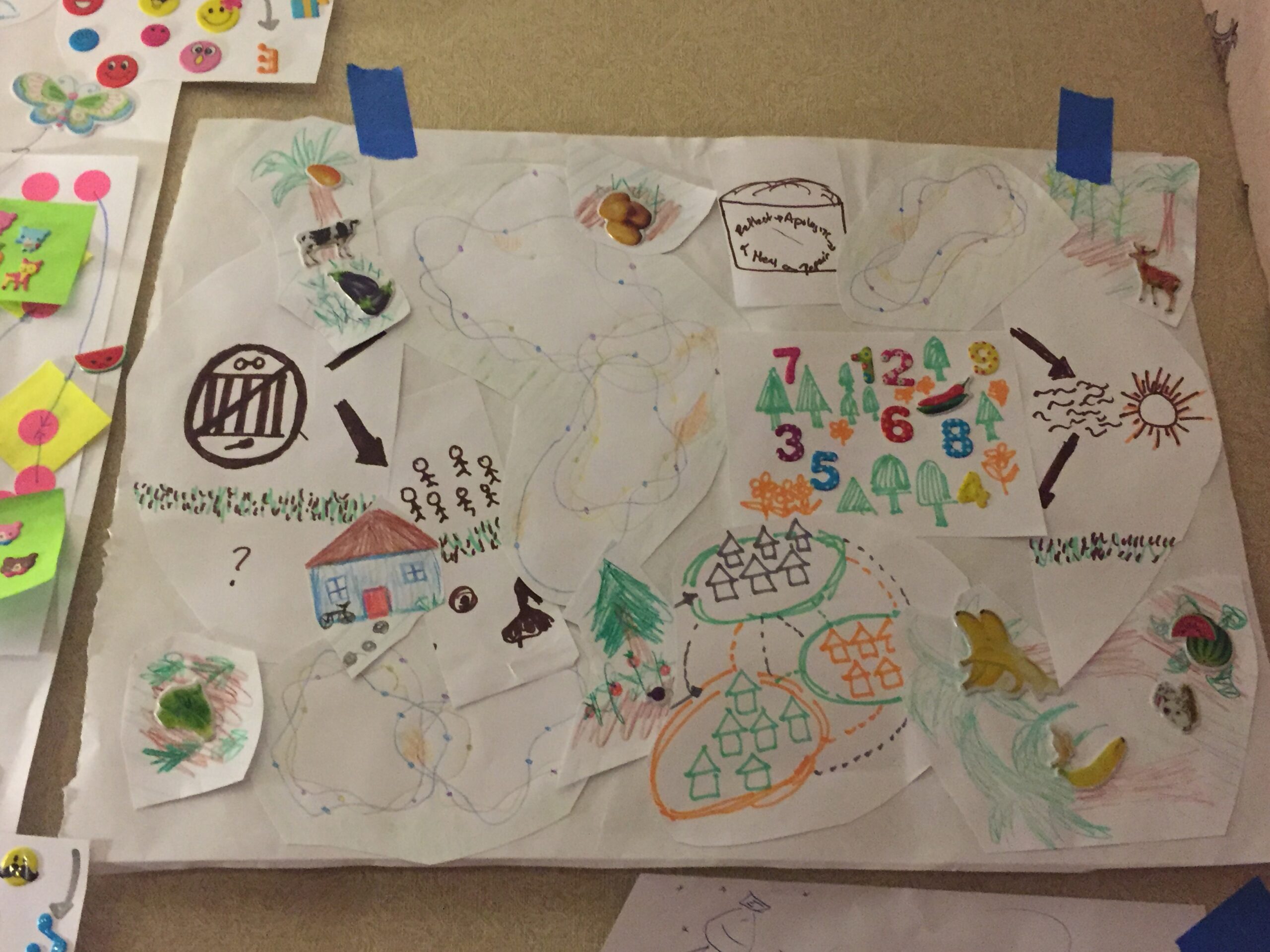
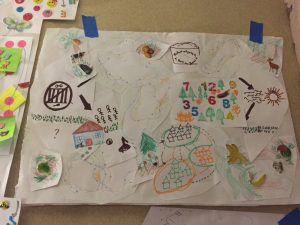 I was curious – and slightly worried – about how the GEL3 cohort would react to the last minute change of location. Amazingly, the “GEL magic” still operated. It was fascinating to see how, within a matter of hours, the dull and soulless 20th floor Montreal hotel conference room came to life, and felt warm and familiar. A flurry of ideas, drawings and visual depictions of systemic change soon adorned the tired, beige walls. To ground participants in their surroundings, Enei and Sofia inaugurated a makeshift altar – using a candle, a glass of water taken from a nearby stream in Mont Royal park – where people could place personal objects or messages. A GEL3 “library” was set up in a corner of the room for people to share books and other reading material with the rest of the group.
What also made the space so special was the succession of emotional moments and deep and, at times, difficult conversations that punctuated the retreat. If I were to choose one of them, it would, without doubt, be Enei’s workshop on day 3 (Sunday 3rd November) on colonialism and the need to decolonize philanthropy. Drawing on her own personal experience as a Navajo and activist, and on the collective wisdom of the first nation peoples she defends, Enei hosted a role-play exercise where GEL members were invited to relive the plight of first nation communities. The cohort was divided into three groups – the elders, the youth, and the adults –, each standing or sitting in a particular place within the community – the youth at the centre, the adults on the margins of the circle, and the elders, sitting in between the youth and the adults. Recounting the tragic story of first nation communities in North America, Enei slowly walked around the room, gently inviting participants to step out of the circle. Within minutes, only a handful of participants remained. The room was in total silence. The emotion was intense. Many were in tears. When asked to share their thoughts, several participants drew on personal experiences or those of loved ones and communities. They explained how the exercise had revived feelings of hurt, suffering and injustice. It was a challenging but important experience. A powerful moment that will connect us to each another and to that 21st floor conference room.
As the Montreal retreat unfurled, I became increasingly aware of the fact that what really mattered was less physical location than physical space. In other words, it was the room that connected us, not our surroundings. It was the fact of physically being in a shared, “brave and safe” space where we could freely engage in deep and transformative conversations that was important. In a philanthropy sector full of overworked programme officers, where time is money, failure, self-doubt, “taking a step back” or questioning dominant assumptions are not on the table, the fairly straightforward act of providing time and physical space to co-create and co-learn becomes revolutionary.
 What applies to the GEL and philanthropy also applies to the rest of society. As Eric Klinenberg explains in his book, Palaces for the People, “social infrastructures” are key to transformative change. As Klinenberg explains when discussing the role of public libraries, parks or schools, the “fact of spending time in public social infrastructures requires learning to deal with […] differences in a civil manner” (p.44). As he goes on to write, “in a world where we spend ever more of our time staring at screens, blocking out even our most intimate and proximate human contacts, public institutions with open-door policies compel us to pay close attention to the people nearby” (p.44). Recent movements such as Occupy, the 15-M movement in Spain, or the Yellow Vest roundabout occupations in France reflect an urgent need for more direct, unfiltered, place-based human interactions, as well as their transformative potential. Physical contact, rather than just ideology, forms the basis for new collective imaginaries and radical change.
In its own, modest, peculiar and ephemeral way, the GEL can be likened to these movements and social infrastructures, providing philanthropy sector workers with a physical space in which to interact, deal with their differences, and move things forward. It provides a space for conversation which, as Sherry Turkle, a psychologist and scholar of science and technology at MIT, explains (in Klinenberg’s book) is “the most human – and humanizing – thing we do… It’s where we develop the capacity for empathy. It’s where we experience the joy of being heard, of being understood. And conversation advances self-reflection, the conversations with ourselves that are the cornerstone of early development and continue throughout life” (p.41).
While this focus on process and group dynamics may seem futile and out of sync with urgent, “real world problems” – addressing the multiple and interconnected systemic crises that we face, and imagining and bringing about radical change –, it actually forms an essential first step on the way to truly systemic thinking and change. The simple act of providing and holding a space for honest conversations becomes subversive and transformational.
Did Edouard piece inspired you and you’d like to know more about this program? Visit our website and register to the first GEL Webinar of 2020!