
By:
I recently joined a roundtable discussion to discuss what is needed to move beyond philanthropic dependency towards more equitable, locally rooted, and sustainable approaches to resourcing civic action. I was asked to reflect on what makes conventional philanthropy what it is, and what might need to change. I left inspired to continue reflecting.
Dependency is very much baked-into current economic systems
Rethinking dependency is, at the end of the day, a rethinking of economic systems. Unfortunately, dependency is baked into the way capital moves through the unjust global economy.
Dependency by design
Developing countries held $11.7 trillion in external debt in 2024. That year alone, they paid $384 billion in interest to external creditors. Between 2022 and 2024, developing countries actually paid $741 billion more in external debt principal and interest than they received in new financing. (source) (source)
We need to be careful when we talk about “dependency” as though it is simply a problem of communities receiving too much from elsewhere. There is a much bigger structural story: capital is constantly being extracted from the Global Majority through debt service, unequal financing costs, trade and other mechanisms, while development, aid and philanthropic capital arrives as a much smaller corrective flow.
After centuries of extraction, of course communities are looking for their resources from countries that stole them. Progressive philanthropy and people working towards economic justice understand this complex economic story. Rethinking dependency is therefore a political organizing project much bigger than philanthropy. But while we work to transform those larger systems, I think we also have to ask: how much of the capital that does move into these places are we actually trying to liberate and how differently could we make it move?
The scale of capital to organize in MENA
We don’t have access to particularly good data on philanthropic flows specifically into MENA. And philanthropy is only one of several kinds of money moving into the region. There is official development assistance (ODA), or aid, and other government funding; humanitarian finance; corporate and CSR money; and remittances from people living and working abroad.
Putting these different pools alongside one another is useful, even though they are not equivalent forms of finance.
Between 2020 and 2023, official development assistance, or aid, amounted to $769.8 billion, compared with $68.2 billion in private philanthropic funding for development over the same period. Philanthropy was therefore roughly one-tenth the size of aid or ODA. (source)
The $68.2 billion figure is global so we cannot simply carve a precise MENA figure out of it. But it gives us a sense of scale. For 131 countries classified as “low-and-medium income countries” by the World Bank, $656 billion in remittances reached them in 2023 alone. Remittances are, in fact, larger than both foreign direct investment and official development assistance globally. In MENA alone, remittances were estimated at around $61 billion. (source)
All these numbers show that for MENA and other global majority countries, philanthropy is not the big bucks. And yet it is a particular kind of money that is extremely essential if we aspire to build new systems.
Unlike remittances, which largely flow directly to households and families, or ODA, which is public money governed by state and institutional priorities, philanthropy has the potential to be relatively flexible, responsive, patient and willing to take risks. That is precisely why I think we should be asking more of it.
The pool of philanthropic money is already so small, what are we using its particular qualities for?
The global data is striking. Of the $68.2 billion in philanthropic funding between 2020 and 2023, only around 7% went to the broad category of civil society and government. Meanwhile, the majority went to very specific thematics like health or education. (source)
This distribution tells us something about how philanthropy tends to organize itself: around recognizable sectors, interventions and outcomes, rather than around the less legible infrastructure that allows civic & governmental ecosystems to develop and sustain themselves.
And this is happening at a moment when the funding environment in MENA is itself becoming more constrained.
An early scan by DARPE of more than 10,000 publicly advertised funding opportunities found a roughly 30% decline in available grants to the region between January–June 2024 and January–June 2025. (source) This isn’t a comprehensive measure of all money entering the region, but it gives us an indication of a shrinking and more competitive funding environment. This is what brings me to the boom-and-bust problem.
The Boom-and-Bust Problem of Philanthropy
I don’t think philanthropy talks honestly enough about the fact that its own capital is cyclical. Money comes in around a crisis, a political moment or a new global priority. Organizations expand, new initiatives emerge and people find each other. Then the attention moves. A foundation changes strategy. A crisis drops out of the headlines. The money contracts. And the organizations are expected to absorb the shock.
We tend to treat these moments as exceptional. But for organizations working in MENA, this is often a recurring condition of working with external funding. The boom-and-bust cycle is structural.
When funding disappears, organizations are told to diversify, become more efficient, demonstrate their relevance and find new donors. But if we know that philanthropic capital will periodically contract, why aren’t we building for that reality when the money is available?
This is where I see an important distinction between conventional and solidarity-based philanthropy. Solidarity-based funders understand that they are not simply financing a project. They are entering into a relationship with people and movements navigating uncertain political, economic and civic conditions. They are more willing to take risks alongside their partners, including when the work becomes politically difficult or when conventional risk frameworks would recommend stepping back.
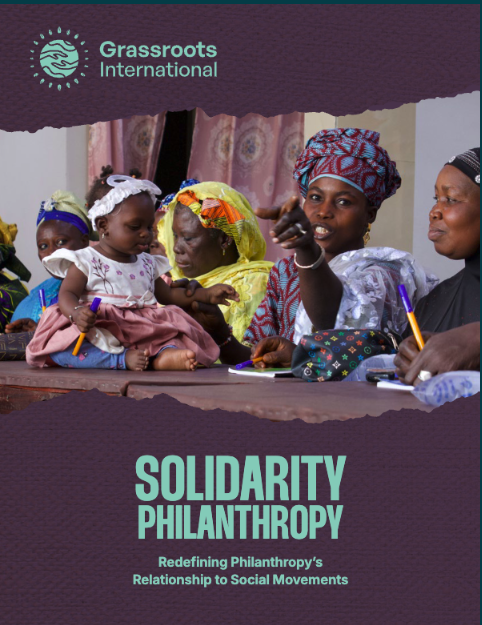
How can philanthropy invest money into structures that enable the navigation of periods of retrenchment: what reserves can it build, what relationships can it strengthen, what infrastructure can it help purchase, what can remain when the funder leaves?
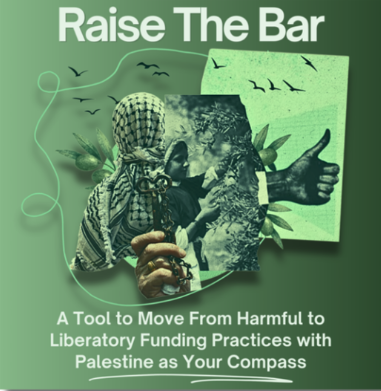
Progressive philanthropy is doubling down on these questions and new resources are popping up like the Raise the Bar toolkit. It asks philanthropy to think beyond effectiveness towards power, accountability, solidarity and shared risk. It makes space for a different understanding of risk: not simply the risk a funder takes by giving money, but the risks movements and communities carry when funders withdraw, restrict their support or remain silent.
Funders who take risks
I don’t want this to sound like a story of an imaginary philanthropy that doesn’t exist. There are already funders doing things differently.
Across the EDGE network, we see funders experimenting with non-competitive grantmaking, participatory decision-making, multi-year flexible funding, movement accompaniment, shared risk and new approaches to financial resilience.
And there are funders trying to redistribute capital, challenge assumptions, and organize funders collectively rather than treating each foundation as an isolated institution.
This philanthropy exists and spotlighting it is part of the thinking behind our Funding Movements POD: a space for EDGE members to move beyond talking about movements to actually examine how funding practices can change. I’m excited to share more of these stories soon. They offer a deeper sneak peek into a progressive justice-focused philanthropy that understands risk, capital and its own role differently.
More soon! Because even if philanthropic capital is relatively small in many ecosystems, including in MENA, compared to other capital, it is most likely to fund radical alternatives.
We should continue to be much more ambitious about what we ask philanthropic money to do.